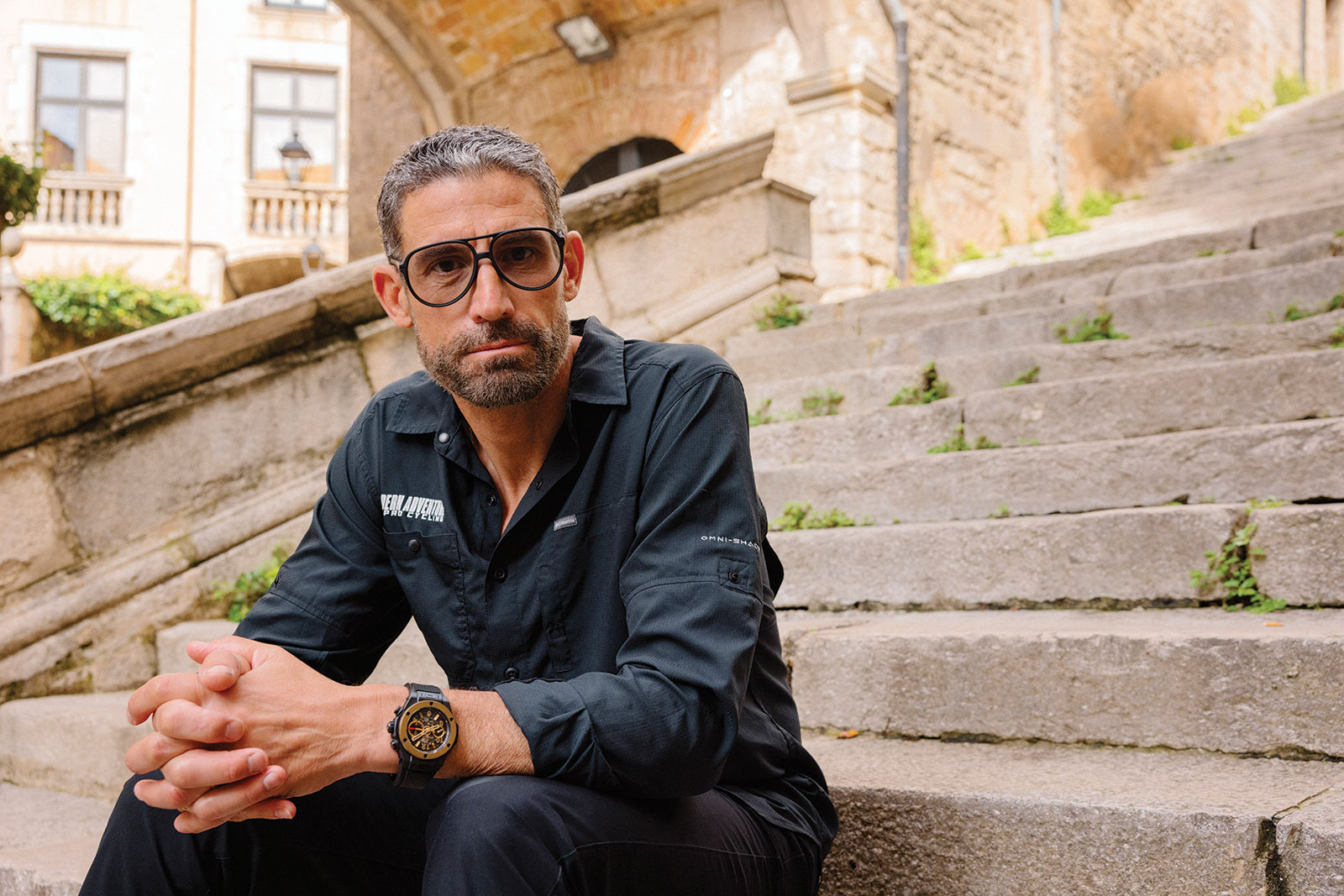
From supporting Grand Tour winners to going for victory at Roubaix, George Hincapie has seen and raced it all. Now he’s bringing that experience to bear on his new American team, Modern Adventure Pro Cycling
Words by James Spender
Photography by David Powell
You really win, George.’
‘He says I won, he says he’s sure, but…’
‘You don’t believe me. Our commentators are sure, they confirm it. You win.’
‘Really? Then yeah, that’s good. I’ve very much been needing to win, you know. My directors and the managers, it’s been a long time since I won but they really believe in me. And I know that I can win, I just need to get everything right… I finally got it, a big one.’
If one moment summed up an approach to pro cycling, it’s that one. Sat in a chair, clearly exhausted, George Hincapie is at first disbelieving, then philosophical, then quietly happy. He’s just won the 2001 edition of Gent-Wevelgem, coming from last wheel in a five-man break to pip Léon van Bon by a tyre. It’s as dramatic a finish as bike racing ever sees, and all the more theatrical given it’s the 28-year-old’s first major win since turning pro in 1994.
Seven years is a long time for all involved to keep the faith. But where other riders might punch the air, exuberantly embracing teammates before giving an emotional interview, Hincapie is matter of fact in the face of this victory, ascetic even: Sunday is Paris-Roubaix, he’s now one of the favourites and there’s still work to do.
Four days later Hincapie finishes fourth at Roubaix (no mean feat given four of the top five are riders from Patrik Lefevere’s Domo-Farm Frites team) and by the summer he’s back racing as a domestique at his sixth Tour de France. Cycling is never finished, and despite having retired 14 years ago, neither is George Hincapie.
Player turned manager
‘I still remember it. I was in Como in Italy and I got a suitcase full of team Motorola gear, all in plastic bags, and I’m like, “Whoa, I’ve never seen so much kit in my entire life,” and it was all mine. I will never forget that feeling and I hope they had a similar feeling when they got all their stuff.’
It’s March and Hincapie is speaking remotely from Girona where he’s gone to help set up his new team’s service course. That team – with all its new kit – are Modern Adventure Pro Cycling, which Hincapie and brother Richard announced in June last year and which took to the tarmac on their newly minted Factor bikes at the AlUla Tour in January.
Like similar outfits – notably Fabian Cancellara’s Tudor Pro Cycling – Modern Adventure are initially competing with a ProTeam licence (one rung down from the WorldTour) but will receive invitations for some WorldTour races. Then, in seasons to come, the great hope is wildcard entries for the Grand Tours and eventual promotion to the WorldTour itself. Crucially, they will do all this while ‘maintaining a minimum 50% American riders, which is a mandate from my co-owners’, says Hincapie.
Lofty goals, but early signs are promising: a fourth place in GC for South African Stefan de Bod at the AlUla Tour, three top-ten stage finishes for Canadian Riley Pickrell at the UAE Tour, and a strong showing at the Volta a Catalunya. In typical Hincapie form, though, he is level-headed in his plans and current assessment, if quietly proud.
‘We were expecting to get our asses kicked in many ways, but we’ve actually gotten results. We’re getting way more invitations than we had anticipated and we’re getting tons of compliments from other riders, general managers, team owners on how good the team looks and how well we ride, so that’s already a huge accomplishment for me personally.’
Make no mistake, Modern Adventure is a personal project for Hincapie. There is the elephant in the room of course, a ban for doping as a rider and subsequent erasure of a period of results, and there are many out there who’ll want to say this is a redemptive undertaking. But look a little closer at Hincapie’s background and there are more compelling conclusions for the armchair psychologists to draw.
Passing it on
‘Growing up in New York in the 1980s, it wasn’t a traditional path to cycling,’ says Hincapie of his childhood in Queens. ‘My father loved the sport, he got me into it, and racing in Central Park and Prospect Park with a bunch of Europeans and South Americans as a 12-year-old kid really helped pave the way for the rest of my career.
‘I got pushed around by these adults who took it really seriously, so by the time I got to Europe and racing in Belgium on small roads and cobblestones, it didn’t seem that chaotic to me. Like, OK, this isn’t quite as crazy as racing in New York in the snow, with taxis pulling up and runners and people trying to crash you. But I was really fortunate early on when I got support from New York City cycling aficionados like Fred Mengoni and Kissena Cycling Club [a local New York club], who helped my family out with equipment and some kit.’
Mengoni is a pivotal figure. An Italian immigrant who made his fortune in real estate, in the 1980s he helped establish the US’s first UCI-recognised professional cycling body and set up his own team, GS Mengoni, which nurtured a young Hincapie. Hincapie credits Mengoni with steering him towards his first pro contract in 1994 at Motorola, itself an upstart American team trying to break established cycling ranks – an uncanny similarity not lost on Hincapie.
‘We got yelled at all the time, “Go home!”, and rightfully so,’ he says at the mention of those early Motorola days. ‘Sometimes we were in the way, we didn’t know what we were doing. So I take the same approach with my team as we’re also a small American team. I told our guys, “Look, you won’t be handed a ton of respect by the peloton. You guys need to earn the respect. Race together as a team, trust in each other, make an impact where you can and the results come second to that.”’
This, in many respects, seems to be Modern Adventure’s secret weapon. It’s run by ex-racers who’ve been there, done it and worn the jersey, from Hincapie’s old teammate Bobby Julich to recent WorldTour retiree Joey Rosskopf. And then, of course, there’s Hincapie himself.
His career spanned 19 years and in that time Hincapie raced 17 consecutive Tours de France, completing 16 of them back-to-back; he rode 50 Monuments, finishing 46 and achieving 16 top tens; and he supported three Tour de France winners in Lance Armstrong, Alberto Contador and Cadel Evans. Yes, many of those statistics have been adjusted or erased and with good reason, but nonetheless there isn’t a hint of ego – just calm pragmatism – when Hincapie says, ‘I told our riders from our first December camp that we’re not fans or businesspeople running this team. We’ve been in the war with you. We’ve been in every scenario that you can experience
in the peloton so you can rely on us.’
Disaster, tragedy, hopes and dreams
At the time of our meeting, Modern Adventure has yet to take on Paris-Roubaix, its biggest race yet (their best rider, New Zealander Ben Oliver, would finish 47th). Hincapie is fixed squarely on this race, and though he won’t be attending every race this season, he will make efforts for the big ones.
‘Especially Roubaix, which I have a big affinity for. We’ll be there to do our best, we’ve been out and done recces, but I’m not telling these guys, “Hey, I need you to finish top ten.” It’s a very tough task to have a great experience at Roubaix so they just need to do everything they can to survive. It’s a dream for anybody to be at the start line but I’m not going to sugarcoat it. It’s going to be absolute hell; it’s going to be the worst pain of your entire life. You’re going to take more risks than you probably ever have in your entire life, but just try to be there and race with grace and gratefulness.’
Indeed, 17 starts with eight top tens probably gives you a unique perspective on a race that is about more than just the cobbles, especially when you factor in near-miss disappointments and horrendous crashes.
‘I finished second in 2005. I got to the finish with Tom Boonen, the best sprinter in the world, which was just unlucky at the time. Then the next year my steerer tube snapped [45km to go, with Hincapie in a strong position for a win]. Afterwards Trek did like a hundred-page report on what happened and said essentially I crashed in the first hundred kilometres, which apparently compromised the steerer’s integrity, so it slowly started chipping away over the sectors, and then 120km later it just snapped on me.’
Hincapie sustained a separated shoulder and broken collarbone and took a month off the bike, but looks back on it now with hallmark stoicism.
‘It sucked. It was a really bad day in my career, but as a professional cyclist you’ve got to get back on otherwise you’re gonna be struggling. That said, from that moment on if I ever felt anything strange in the front end of my bike, I stopped immediately and changed bikes.’ (In 2006 he had told the team he felt a looseness in the steering, but it was thought to be a loose headset.)
The danger of cycling is something Hincapie has experienced in the most tragic of ways – his Motorola teammate, Fabio Casartelli, died after crashing on the Col de Portet d’Aspet during the 1995 Tour de France – and it continues to present itself despite being long-since retired.
‘My son, Enzo, races [for Red Bull feeder team Grenke-Auto Eder]; I watch him and the nerves never go away. But even with our riders, in the UAE Tour we had a couple of crashes and of course you’re scared, but it’s part of it. Hopefully the courses get safer but cycling at a high level is dangerous so it’s something we try not to think too much about and hope for the best.’
And so far so good. The team is established, its foundations and funding seem strong, the experience is there at management level, the raw talent is present in the roster and the invitations to race are flying in. But like George Hincapie the rider in 2001, sat on a chair at Gent-Wevelgem, George Hincapie the general manager in 2026 isn’t getting carried away any time soon, despite dreaming some impressive dreams.
‘We’re here to grow organically. I don’t want to put pressure on the guys; I just want them to become better cyclists and to be part of a team they’re proud to ride for. But looking back in ten years’ time? I want to know we gave young American riders a shot to make their dream races, and that we helped reinvigorate the sport in the United States, to have made a real team that American fans, not only the hardcore fans, can say, “This is my team.”’
Hincapie on…
… race craft
‘Back in my riding days I’d do these little drills in the peloton. I would say I’m going to move up a hundred spots without burning one extra calorie, just by finding these holes. I felt it really helped shape my awareness in the peloton. Everybody does the same amount of training now, and everybody has the same amount of nutrition, so it’s all about who can have the most finesse inside of a peloton and who can find ways to save the most energy.’
… Tadej Pogačar
‘A lot of people just automatically assume that because he’s Pogačar he’s going to get to the finish line, but it’s incredible how good at positioning he is, and how he actually gets to the line mostly without crashing and sometimes without teammates. It’s wild to see how dominant he is, how he goes with 60, 70, 80km to go, and it’s not like it’s a surprise attack but he still rides away from everybody. I don’t see any chinks in his armour.’
… then and now
‘I think the team realises they have it better than we ever had it – like the bike, the Factor One they ride, it’s awesome. And the nutrition. I look at my son, who’s a serious cyclist, and I look at how much he eats during training. Back in our days, if you came home completely bonked and out of energy you’d had a good training ride. The mindset is completely different now. These guys are so dialled in with their nutrition and you see how much stronger they are at the end of the races now.’